

STOCKLAND SUPPLY CHAIN MANAGEMENT
A Circularity Analysis
EXECUTIVE SUMMARY
The circular economy opportunity is systemic and requires contribution from governments, primary resource companies, refiners, manufacturers and consumers to deliberately create circular material flows and – importantly – circulate value.
In today’s linear economy we place value on the function of a product or material for the time it provides the function and not on the material value which is often discarded as waste. In a circular economy products and materials are valued for both their functionality and their materiality as well as the value that they contribute to the system.
Stockland has a substantive opportunity to contribute to the development of a circular economy in Australia. The staggering 20.4 million tonnes of construction and demolition (C&D) waste generated 2017/2018 in Australia is testament to the need for leadership and action toward the creation of a circular economy.
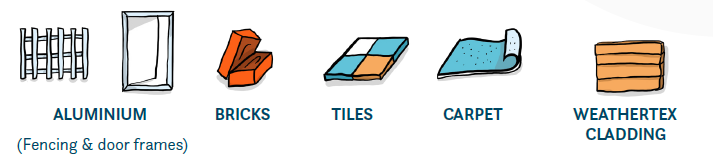
The purpose of this report is to provide Stockland with a clear and robust understanding of the upstream and downstream circularity of selected materials (aluminium [fencing and door frames], bricks, tiles, carpet and weathertex cladding). In addition, the report provides the carbon footprint (scope 1 and 2 emissions) for manufacturers and/or the materials. Lastly, national and international best practice examples are provided.
Our findings highlight that Stockland has a solid foundation to implement circularity in internal processes such as design, procurement, and reporting, however, we
have identified six systemic challenges to creating circular material flows. Furthermore, a multiplicity of circular
economy opportunities and challenges were identified within the specific material supply chains.
SCOPE
Coreo analysed upstream supply chains from Stockland’s Coomera Foreshore and Vida North Lakes Medium Density Project to assess the circularity of five materials:
ALUMINIUM
Fencing Factory
(Aluminium fencing manufacturer)
Hodge Systems
(Aluminium door frame supplier)
Raumplus
(Aluminium door frame manufacturer)
BRICKS
Austral Bricks
(Brick manufacturer)
TILES
National Tiles
(Tile supplier)
National Ceramic Industries Australia
(NCIA) (Tile manufacturer)
Unidentified China based manufacturer
(Tile manufacturer)
CARPET
Godfrey Hirst
(Carpet manufacturer)
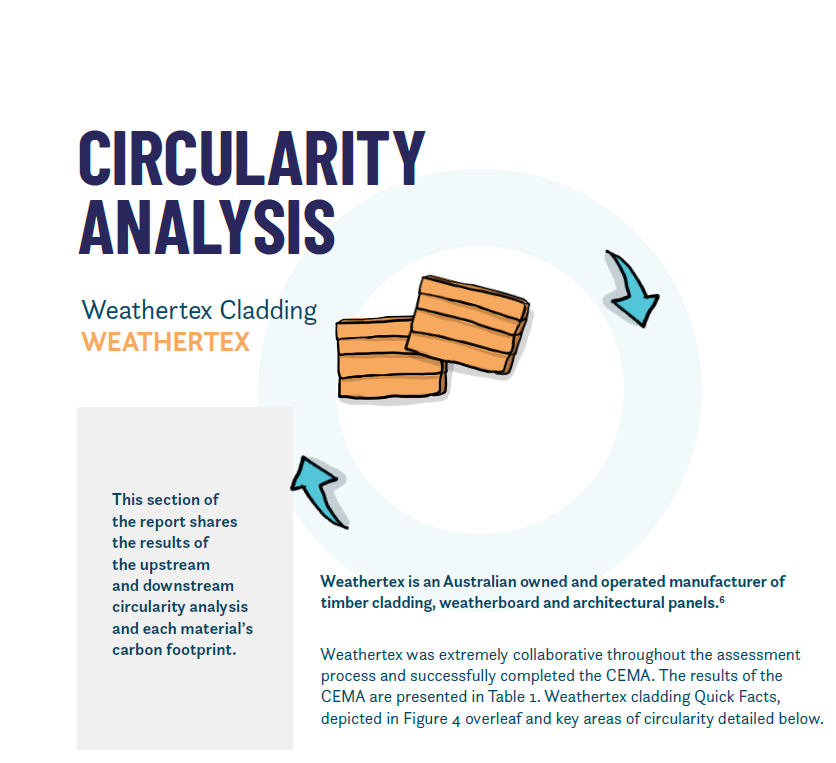
Weathertex cladding
Weathertex
(Cladding manufacturer)
In addition, Coreo analysed the downstream material journey from the Coomera Foreshore and North
Lakes Vida project sites to assess the circularity of the five selected materials from disposal onsite through to their next use/s or final disposal. Furthermore, the carbon footprint (scope 1 and 2 emissions) for manufacturers and/or the materials were assessed. In some cases information on scope 3 emissions has been obtained. A diagram on the boundaries of scope 1, 2 and 3 emissions has been provided in Appendix 1. Lastly, national and international best practice examples were reviewed and assessed with examples provided. The circular case studies have been included in Appendix 2.
METHODOLOGY
To analyse and measure the upstream circularity of the five selected materials and determine the product manufacturers degree of maturity in transitioning towards a circular economy Coreo developed a Circular Economy Maturity Assessment (CEMA) as included in Appendix 3.
The CEMA includes both qualitative and quantitative measures. It is important to consider how circular a company’s product is as well as the company as a whole as this analysis provides a systemic understanding of both the company’s circular economy action and intention.
The quantitative assessment analyses input and output material flows and provides a score based on how circular a company’s products and materials are today. The inflow circularity measures the percentage of recovered and virgin (renewable and non-renewable) inflow materials as well as the percentage of renewable energy used in production.
The outflow circularity measures the percentage of recovery potential in products against the actual recoveryrates for the industry or region. The final score for the quantitative assessment is determined by the average between circular inflow and outflow percentages.
The qualitative assessment evaluates indicators in four thematic areas – strategy & planning; innovation; people
& skills; and external engagement to determine an organisations degree of circular economy maturity – from isolated initiatives and actions; to deliberate and then scalable strategies; through to processes that have a systemic impact across the supply chain as shown in
Figure 1.
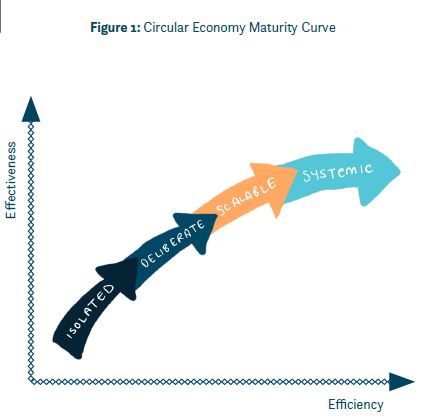
- Isolated: Reactive and isolated sustainability,
efficiency, and community initiatives - Deliberate: Intentional circular economy
initiatives but without system linkages - Scalable: Circular economy initiatives replicated
across asset classes and locations - Systemic: Clear circular economy vision,
strategy, targeted action and measurement
To do this, Coreo interviewed the contracted builders onsite in regards to waste generation for the selected materials and the reasons for this. Following this, Coreo engaged with waste contractors to quantify total volumes of waste from the project sites and completed two site visits, one to the transfer station where the construction and demolition (C&D) waste is sorted and one to the landfill where the remaining C&D waste is disposed of. The objective being to identify to what extent these materials are circular and to what extent they could be circular in the downstream supply chain.
To augment the upstream and downstream circular economy assessments and define the systems and processes that begin a materials journey from Stockland, Coreo engaged with Stockland’s sustainability, project management and procurement teams. In addition to stakeholder engagement, Coreo reviewed project, material and sustainability schedules, supply chain management approaches, as well as architect and design documents to ascertain a detailed understanding of design, procurement, material selection and reporting practices.
To determine the embodied carbon of the selected materials Coreo directly engaged the companies with a request for independently verified information such as Environmental Product Declarations. Where this information was not available Coreo reviewed publicly available literature.
To share best practice, Coreo completed a literature review, analysed national and international case studies and engaged waste management companies across Australia.
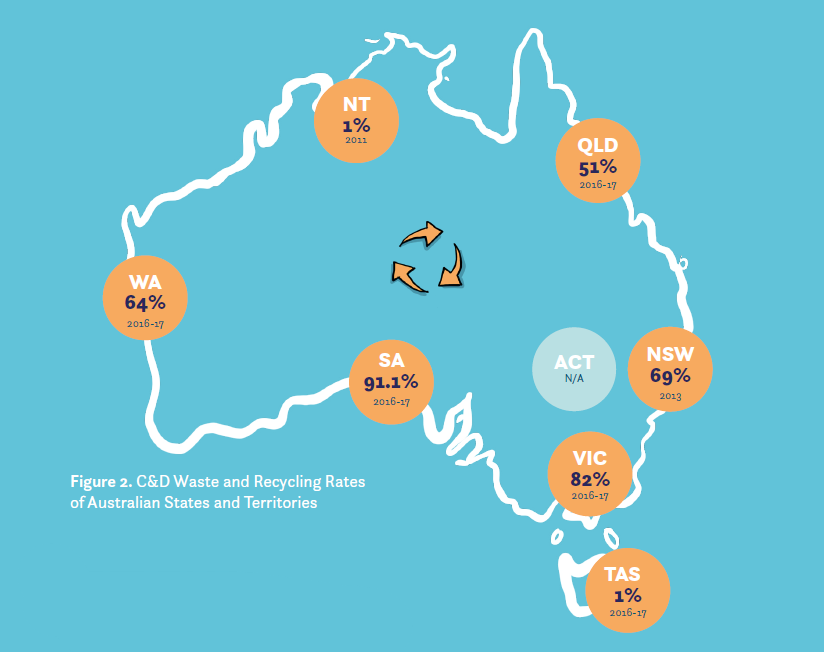
As stated on the Australian Government’s Department of Agriculture, Water and Environment website referring to a report commissioned in 2011, “resource recovery rates are highest in those regions where there is strong market demand for recycled C&D materials, with well-defined and well-publicised specifications supporting the use of recycled products”. 2
Engaging waste management companies during product and material selection is critical in increasing resource recovery rates.
According to Bingo Industries’ sustainability report, the waste management company has plans to develop a Recycling Ecology Park at Eastern Creek, that will broaden their range of processed end products. 3
They have also expressed interest in collaborating with Stockland to create new products from waste streams.
CREATING A CIRCULAR ECONOMY FOR MATERIALS
The circular economy is an economic model that is restorative and regenerative by design. It is underpinned by three key principles: 4
1 Design out waste and pollution
2 Keep products and materials at their highest value for as long as possible
3 Regenerate natural systems


In today’s linear economy we place value on the function of a product or material for the time it provides the function and not on the material value which is often discarded as waste.
In a circular economy products and materials are valued for both their functionality and their materiality as well as the value that they contribute to the system. Creating a circular economy for materials firstly requires an understanding of the types of materials being introduced in the system.
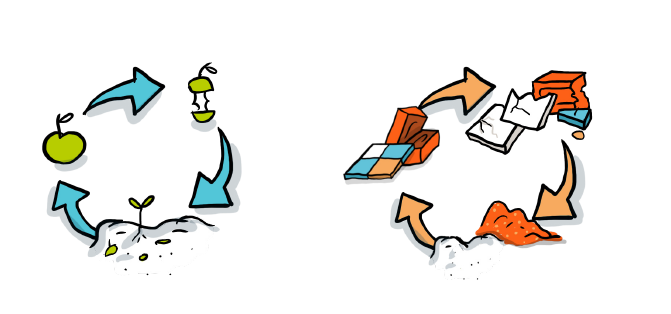
The circular economy distinguishes between technical and biological materials. Biological materials such as cotton, food and wood, are treated as nutrients in a circular economy. These materials should be returned to regenerate our natural systems, such as our soils, to provide renewable resources for the economy. Technical materials, such as steel and oil based plastics, are treated as hard durables that need to be recovered and restored through strategies like reuse, repair, remanufacture or in the last resort recycling. It is important to note that no material ever leaves our biosphere; they just change form depending on how they are valued.
In line with the second principle of a circular economy once the material is known to be technical or biological, the focus needs to be on keeping the material at its highest value for as long as possible. This means that the material is not sent straight through to biological composition after first use. Biological materials can be treated through the technical cycle through repair, reuse, remanufacture etc. Using softwood as an example, adhering to circular economy principles, would mean identifying the strongest timber in the mill and diverting this for Glulam or Cross Laminated Timber (CLT) production. Once this timber becomes a higher
value product, we have more chance of keeping it in the cycle for longer.
For example, hardwood used for high quality furniture remains in use far longer than lower quality chipboard furniture and has a higher potential for reuse. Also, CLT panels could be designed for reuse and/ or remanufacture in a component based construction system, likewise Glulam beams could be designed for reuse or remanufactured into new (shorter) beams. Only once the technical cycle (repair, reuse, remanufacture, etc.) has been exhausted would the material be sent for recycling into products such as chipboard and only at the end of that cycle would the product finally swap back to the biological nutrient cycle through to biological composition, or energy recovery. 5


“Coreo’s Circular economy assessment was a good reminder to all involved at Weathertex of the importance of the circular economy ethos. Weathertex will do more in this area as part of our continual Improvement strategy”
Andrew Savage
Key circularity highlights include
Upstream
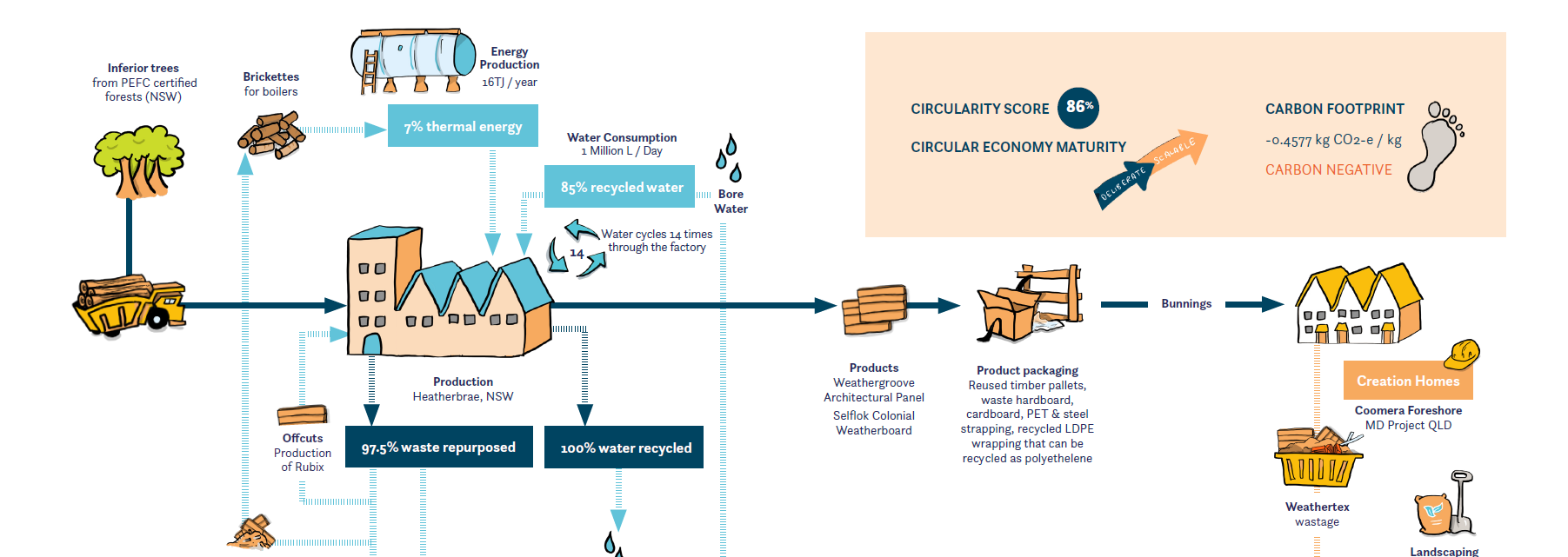
• Weathertex cladding is 97% hardwood timber, 3% paraffin wax and less than 1% acrylic primer, titanium dioxide, and tinted acrylic. No toxic or hazardous chemical additives are used enabling the product to be recoverable and used to regenerate the natural system.
• The Weathertex products assessed are carbon negative, meaning they are better than zero carbon.
• The timber used in Weathertex’s products is from inferior trees considered a waste product of saw log harvesting and thinning operations. The timber is sourced from PEFC-certified suppliers in New South Wales (NSW).
• 97.5% of all waste materials generated from the production of Weathertex’s products are reused. Production offcuts are used to make smaller Rubix Panels and reject boards are used to create briquettes that displace coal in the combustion boilers that power the facility. This enables 7% of total energy consumption to be from renewable sources. Other by products that are beneficially reused on site or offsite include sawdust and trimmings, boiler bottom ash, timber/pellet waste, paper, oils, and greases and lubricants.
• Weathertex uses approximately one million litres of water per day, of which, 85% is drawn from an onsite bore that is fed by an onsite aquifer and recycled water from the facility. The bore water used in the manufacturing process is circulated 14 times through the Weathertex production facility before being treated and used to irrigate over 70 hectares of pasture and woodlands onsite. The irrigated water returns to the aquifer, ready for its eventual reuse in the facility closing the water loop.
• Weathertex uses waste hardboard, recycled low density polyethylene (LDPE) plastic wrapping and used pallets for their packaging.
• Weathertex products have a life expectancy exceeding 50 years (for primed products).
• Several internal processes and initiatives in sourcing, production, distribution and end of life are aligned with the principles of the circular economy. Weathertex stated that they would be including the principles of the circular economy in their continual Improvement strategy.
Downstream
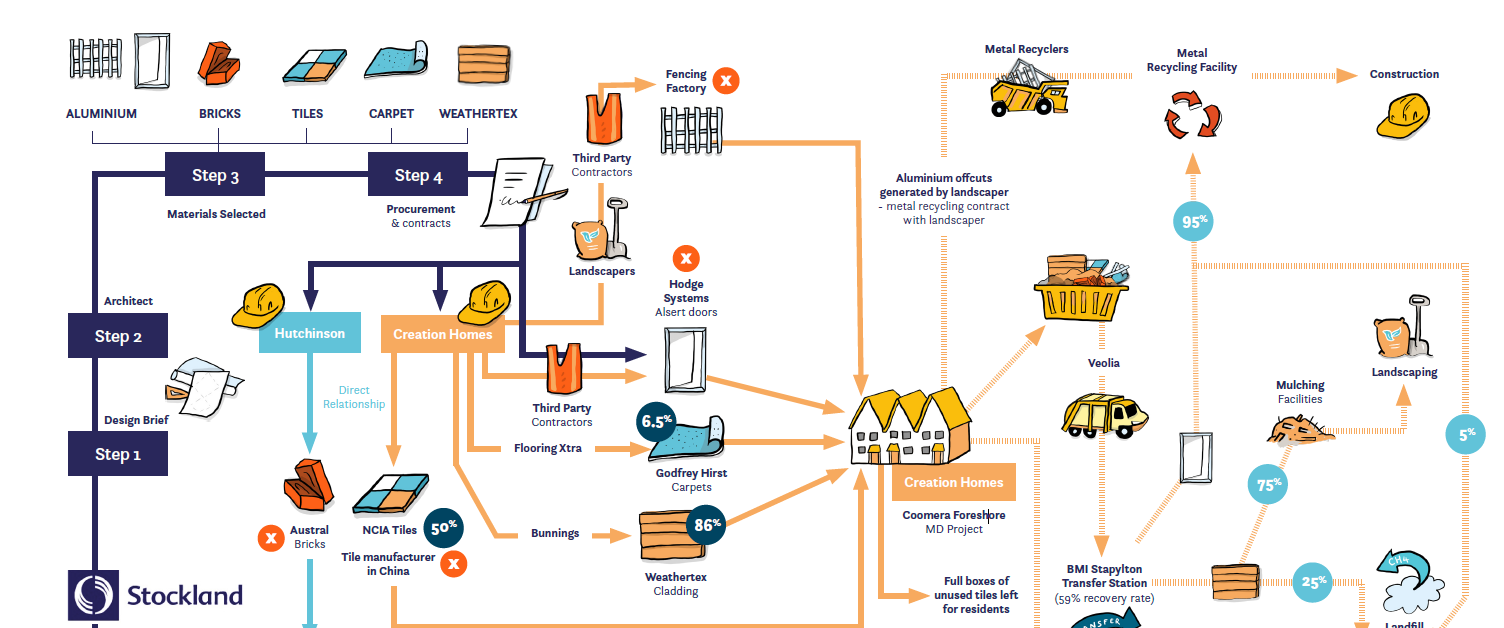
• The majority (approx. 75%) of Weathertex products (including primed products) at their end of life are recovered, sent to a mulching facility and used as an additive for compost. This was confirmed on a site visit to the resource recovery facility for the Coomera Foreshore Medium Density Project.
QUICK FACTS
- Circular economy maturity assessment (CEMA): Completed
- Quantitative circularity score: 86%
- Products Assessed: Weathergroove Smooth Architectural Panel; Selflok Colonial Smooth Weatherboard
- Virgin renewable material in products: 97% (Virgin but renewable & sustainably sourced )
- Repurposed waste: 97.5%
- Renewable energy: 7%
- Water consumption (production facility): 1 million L / day
- Use of recycled water: 85%
- Water recycled: 100% (not accounting for evaporation)
- Carbon footprint: -0.4577 kg CO2-e / kg carbon negative (provided by manufacturer)
- Product’s recovery potential: 100%
- Product’s actual recovery: 75% (based on waste company interviews and site visits)
- Global GreenTag (Environmental Product Declaration) certified: Yes



Subscribe
Sign up for exclusive Weathertex tips and trends sent straight to your inbox
