


COMPLIANCE PATHWAYS AND THE NATIONAL CONSTRUCTION CODE
Compliance Pathways and the National Construction Code
INTRODUCTION
In the Australian building sector, non compliance remains a major issue. Studies show that defects relating to cladding are prevalent throughout the country.1 Fire protection, waterproofing, roof and rainwater disposal, and structural issues, are among the most common areas in which defects in Australian buildings are found.
What factors are contributing to this widespread non-compliance? Industry representatives suggest that human error plays a significant role resulting in the misuse of building products. Underlying issues like a lack of product training and a lack of understanding of product certification schemes are likely contributing factors. There are also regulatory concerns, such as the need for greater consistency between the National Construction Code (NCC) and Australian Standards. Non-compliance causes a host of issues for building projects. Failure to comply with building regulations can compromise the integrity of a building project, and harm the reputations of the design and construction firms involved. The high cost of poor performing buildings over their lifespan, including the cost of remediation and repairs, can place undue financial burden on owners and lead them to financial ruin.
So what can designers and specifiers do to avoid compliance issues when selecting building products? In this whitepaper, we discuss the pathways to compliance under the NCC and the Evidence of Suitability requirements. In doing so, we take a closer look at the CodeMark product certification scheme and how it impacts specification for Australian building projects.
Designing Compliant Solutions
Pathways to Compliance
The NCC is a performance-based code comprised of Performance Requirements for all elements of a building, including plumbing and drainage installations. The NCC specifies a minimum level of performance for various building elements. These Performance Requirements are mandatory.
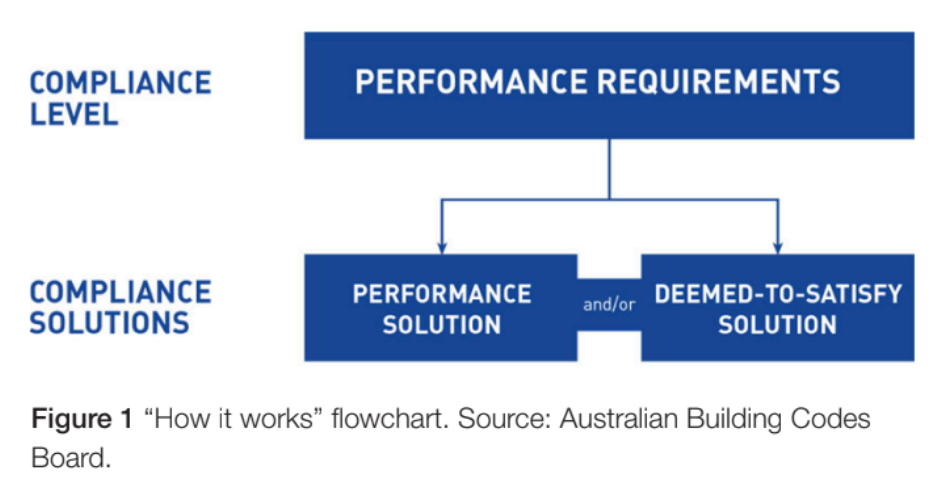
Compliance can be achieved by meeting the General Requirements of the NCC and by complying with the relevant Performance Requirements. For the latter, compliance can be achieved using a Performance Solution or by complying with the Deemed-to-Satisfy (DtS)
Provisions, or a combination of the two. See Figure 1 “How it works” flowchart.
Performance Solution
A Performance Solution can be defined as a “tailored” solution that meets the intended objectives of the relevant Performance Requirements for a given building element.2
Compliance with Performance Requirements can be achieved by formulating a Performance Solution that:
• complies directly with the Performance Requirements;
or
• is shown to be at least equivalent to the DtS Provisions
(the DtS Provisions are taken as the target of the Performance Solution).
A Performance Solution uses one or more of the Assessment Methods in the NCC to demonstrate compliance. Assessment Methods include:
• Verification Methods;
• comparison with the DtS Provisions;
• Expert Judgement; or
• Evidence of Suitability (discussed further below).
DtS Solution
A DtS Solution is one that follows all appropriate DtS Provisions in the NCC. The Australian Building Codes Board (ABCB) describes DtS Provisions as a prescriptive
checklist that specifies the materials, components, design factors, and construction methods that, if used, are deemed to meet the Performance Requirements for a given building element.3 A Deemed-to-Satisfy Solution must comply with the relevant Performance Requirements and must be verified using one
or a combination of the following Assessment Methods:
• Evidence of Suitability; or
• Expert Judgement.
Combination Performance Solution and DtS Solution
When designing a building, a combination of Performance Solutions and DtS Solutions can be used to achieve compliance. The appropriate Assessment Methods must be followed.
EVIDENCE TO SUPPORT COMPLIANCE
Documentary Evidence
An important component of achieving compliance with the NCC is documenting the suitability of the design, construction and/or use of materials to demonstrate that they meet the relevant Performance Requirements. Part A5 of each Volume of the NCC includes the documentation of design and construction provisions. Various forms of documentary evidence, known as Evidence of Suitability, may be used to prove that the materials, products, forms of construction or designs are code compliant.4
Both Performance Solutions and DtS Solutions can be assessed with Evidence of Suitability. Determining the appropriate form of documentary evidence for the chosen solution, and obtaining evidence, is not enough to achieve compliance with the NCC.5 Note that having the appropriate documentary evidence for a specific component is meaningless if non-conforming components are then used.
Choosing the Appropriate Form of Evidence
The most appropriate form of evidence is dependent on the circumstances. In general, new or innovative product components (i.e. materials, products, forms of construction and designs) where the consequences of failure are high will require more rigorous forms of
evidence to prove compliance. By contrast, product components with a long history of use in Australia and a low probability of failure, or where the consequences of failure are assessed as low, will typically require less rigorous forms of evidence.
The Evidence of Suitability Framework
The Evidence of Suitability framework arranges options of forms of evidence in a hierarchy, from most to least rigorous. The forms of evidence are as follows:6
• CodeMark or CodeMark Australia Certificate of Conformity. The most rigorous form of evidence, CodeMark certification is issued under the CodeMark or CodeMark Australia scheme by an accredited certification body, and provides independent confirmation that a building product or system is code compliant. The benefits of CodeMark certification is discussed in detail later in this whitepaper.
• Certification of Accreditation. This certification is issued by a State or Territory accreditation authority under the applicable State or Territory building legislation. The accreditation authority will assess a building component for compliance with the NCC.
• Certification issued by a certification body. This certification provides independent confirmation by a Conformity Assessment Body (CAB) that a building component is compliant with the NCC. The JAS-ANZ (Joint Accreditation System of Australia and New
Zealand) can accredit CABs under an industry-operated building product certification scheme.
• Report issued by an Accredited Testing Laboratory. A report is issued by an Accredited Testing Laboratory to show that a building component has been subjected to particular tests, the results of testing and any other information relevant to demonstrating the component’s suitability for use.
• Certificate or report by a certified engineer/recognised expert. A professional engineer or appropriately qualified person may issue a certificate or report explaining the suitability of a building component, form or construction or design for the proposed application.
• Other forms of documentary evidence such as, but not limited to, a Product Technical Statement. This evidence option allows other technical documentation to be used as evidence and highlights that the above list is not exhaustive.
SIMPLIFYING COMPLIANCE: CODEMARK CERTIFICATION
What is CodeMark?
To simplify the process, certification schemes like CodeMark Australia provide users with a source of recognition for product components that are determined to be compliant with the NCC. These type of certification schemes aim to establish conformity in certification practices thus becoming widely accepted in the market. CodeMark is a voluntary third party building product certification scheme that authorises the use of new and/or innovative products in specified circumstances to facilitate compliance with the NCC. The scheme was established by the ABCB in consultation with State and Territory governments, industry organisations and certifying bodies. It is administered by the JAS-ANZ, on behalf of the ABCB. How Does CodeMark Work? Accredited CodeMark Australia Certification Bodies are responsible for evaluating applications for a Certificate of Conformity in accordance with the CodeMark Australia Scheme Rules.7
A Certificate of Conformity is given only
if and when the product is demonstrated to meet the requirements of the NCC.8
CodeMark is not a compulsory scheme. Manufacturers can apply for certification to demonstrate that a new or innovative product, especially one that has no standard for manufacture, is code compliant. This can be used to increase customer confidence for a product with no or little market history, working as a shorthand summary of the relevant NCC requirements the product meets, itslimitations and how it should be used.
The use of CodeMark certification to reinforce market confidence has grown in building products particularly in relation to cladding systems. Timber, hardboard, fibre cement and brick cladding systems have DtS solutions
supported in the NCC, whereas alternative cladding systems (e.g. ACP and polystyrene cladding) do not. Accordingly, CodeMark provides a path for alternative systems to be recognised and accepted as code compliant, with information on how to install and use the
products in a code-compliant manner.
The popularity of CodeMark grew to the point that manufacturers saw value in achieving certification for traditional cladding systems, even if such systems already had DtS details included in the NCC in relation to their
installation and use. This had a dual effect – not only were manufacturers using CodeMark to boost market confidence in their products, they in turn were helping CodeMark achieve wider recognition across the market.
Benefits of CodeMark
CodeMark offers several benefits in relation to building specification. By providing a source of recognition for compliant products, CodeMark increases certainty in product selection and reduces the risk of industry professionals working with non-compliant solutions. A
CodeMark Certificate of Conformity is also the most rigorous form of evidence under the Evidence of Suitability framework, helping designers and specifiers meet the documentation requirements of the NCC.
CodeMark is the only method that has automatic acceptance by the relevant building authorities.
Depending on the relevant State or Territory legislation, policy or direction, building control authorities may be obliged to accept the Certification of Conformity as sufficient proof of compliance. Stakeholders across the entire supply chain benefit from
the CodeMark scheme:
• Trades suppliers can confidently promote products and assure consumers that specific solutions contribute to NCC compliance.
• Designers and specifiers have a resource in which they can assess and compare building products, and are provided with a clear scope of use for building products (i.e. when and where a product can be used).
• Builders and building owners have increased confidence that the selected product will meet performance expectations.
• Approving authorities and certifiers have an easier job assessing buildings for compliance if the relevant building components are CodeMark certified.
CodeMark increases certainty in product selection and reduces the risk of industry professionals working with non-compliant solutions.
Weathertex
CodeMark Certified Cladding
Weathertex has utilised the CodeMark Australia Scheme to demonstrate that its Selflok and Weathegroove ranges meet the relevant NCC requirements. Choosing a CodeMark Australia certified product will protect your projects from the risk of using non-compliant materials.
Selflok Weatherboard
Weathertex’s Selflok provides a hardwood weatherboard solution that delivers a clean look by using a simple inbuilt locking function. Selflok’s flat-panelled appearance offers a fresh alternative to traditional lapped planks, providing an ideal solution for many types of projects and applications. This cladding system is CodeMark-certified, meaning designers, specifiers and builders can specify and
install this product with confidence. Selflok may also be used as external cladding in bushfire attack levels up to and including BAL 19 construction. The Selflok system offers quick installation and easy use with its hardy and lightweight design. Selflok’s fixing system results in a unique tongue and groove/ flush profile, while the range of sizes and finishes (including primed and natural options) provides design flexibility. The self-locking system allows every board to align perfectly with minimal effort.
Weathergroove Panels
Weathertex’s strikingly modern and CodeMark-certified architectural panel, Weathergroove, is the largest panel product on offer in Australia, making it ideal for covering larger areas in a shorter timeframe. Utilising only eco-friendly materials, and available in a range of profiles (with machined vertical grooves at centres
ranging from 75mm to 1200mm), this versatile cladding solution can be used in endless applications. Fusing minimalist style with the strength of natural timber, Weathergroove is
available as either primed (ready for site-finishing) or with a natural (unprimed) surface that provides a unique appearance with the characteristics and look of raw, undressed timber. No matter what option you choose, Weathertex’s popular cladding solutions retain every measure of durability and safety.
About Weathertex
Australian-owned and manufactured with a better than zero carbon footprint, Weathertex‘s timber cladding is the ideal solution for any builder, architect or designer in search for environmentally conscious and high quality material. All Weathertex products are made from, without any chemical additives, certified state forest or private hardwoods in Australia.
REFERENCES
1 Johnson, Nicole and Sacha Reid. “An Examination of Building Defects in Residential Multi-owned Properties.” Griffith University.
https://www.griffith.edu.au/__data/assets/pdf_file/0030/831279/Examining-Building-Defects-Research-Report.pdf (accessed 3 March 2021).
2 Australian Building Codes Board. “How to Comply with the NCC.” ABCB.
https://www.abcb.gov.au/-/media/Files/Resources/Education-Training/HowToComplyWithTheNCC.pdf (accessed 3 March 2021).
3 Australian Building Codes Board. “How it Works.” ABCB. https://ncc.abcb.gov.au/ncc-online/How-it-works (accessed 3 March 2021).
4 Australian Building Codes Board. “Evidence of Suitability.” ABCB.
https://www.abcb.gov.au/Resources/Publications/Education-Training/Evidence-of-Suitability (accessed 3 March 2021).
5 Ibid.
6 Ibid.
7 Australian Building Codes Board. “The CodeMark Australia Scheme Rules.” ABCB.
https://www.abcb.gov.au/-/media/Files/Resources/Certification/The_CodeMark_Australia_Scheme_Rules.pdf (accessed 3 March 2021).
8 Ibid.

Subscribe
Sign up for exclusive Weathertex tips and trends sent straight to your inbox
